

Introduction

Sometimes, bunion surgery might be recommended when non-surgical treatments no longer help to relieve pain from hallux valgus, or the deformity of the big toe worsens.
Over time, the surgical process for removing bunions has developed significantly, not only improving the overall appearance of the toe post-operation, but the pain, too. Bunion surgery, unfortunately, has the reputation of being extremely painful, but this is no longer the case. There are many modern types of bunion surgery available now which are more sophisticated.
For each patient undergoing a bunion operation, there will be an optimal approach based on the extent of the deformity.
At the London Foot and Ankle Centre, we take pride in providing world-class leading care to our patients, taking time to understand you in detail and building personalised plans around your lifestyle and goals.
When Is Bunion Surgery Recommended?
Your consultant might suggest bunion surgery after discussing your symptoms and evaluating the appearance of your foot.
Surgery is usually considered if:
- You have pain that is affecting everyday activities
- Walking becomes difficult
- Footwear becomes restricted
- The deformity progresses
- Other non-surgical treatments have failed
It is rare that your consultant will recommend surgery for cosmetic reasons alone.
How does Surgery Work?
The overall aim for any surgery is to realign the bones and correct deformity while preserving joint function. There are a few ways surgeons might carry out your bunion-removal procedure.
At The London Foot and Ankle Centre, we regularly use a procedure called the Scarf Osteotomy. This is a well-established bunion removal operation which allows correction of deformity and simultaneous preservation of the normal foot anatomy.
Scarf Osteotomy for bunion correction

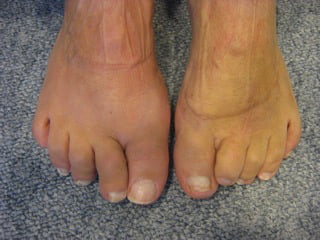
Before and after bunion surgery performed at the London Foot and Ankle Centre
The bones are cut and then held in the correct position using screws without heads. This means the metalwork is buried and not palpable through the skin. Because the bones are held securely with the screws the bone ends do not move.
This means that the optimal position can be chosen and maintained but also the rigidity of the fixation helps considerably to minimise pain and swelling after foot surgery on bunions.
All bunion surgery is associated with the potential for stiffness of the big toe and if this is not addressed, the stiffness can persist. Modern techniques use rigid bone fixation, which allows for early mobilisation of the big toe joint.
Is Bunion Surgery Painful?
Bunion surgery is no longer as painful as it once was. Up until recently, the procedure involved breaking the big toe joint and not using any form of fixation when the bones were cut. This essentially mimicked a fracture and, unsurprisingly, would cause a lot of pain.
Now, the operation is performed differently, by stabilising the bones using specialised screws, allowing earlier mobilisation, more predictable healing and improved restoration of the foot.
As with any operation, some pain and swelling is expected after the procedure, particularly during the first few days. But pain is much more manageable and the recovery is more comfortable than most expect.
Supporting Your Recovery with Expert Physiotherapy
After your operation, your consultant will discuss the next steps of your recovery, including lifestyle changes and pain management. We recommend writing down any questions you might have before your surgery and taking notes that you can look back on during your recovery process.
Immediately after surgery
- Walk in a post-operative shoe
- Weight bearing as advised
- Elevation
- Wound care
Physiotherapy
Physiotherapy is a very important tool in the recovery of patients from bunion removal surgery. Physiotherapists are able to speed up the recovery process by instituting early mobilisation and working on techniques to reduce swelling.
Physiotherapists specialising in foot and ankle conditions are an integral part of the team at London Foot and Ankle Centre providing support and rehabilitation programmes for patients following private bunion surgery (hallux valgus).
- Early mobilisation
- Preventing stiffness
- Reducing swelling
- Restoring gait
- Improving strength
How long does recovery take?
Recovery time for each patient is varied. But, an approximate time line might look like:
2 weeks: wound review
4-6 weeks: bone healing
Return to driving (depending on foot and individual recovery)
3 months: most normal activities
Up to 12 months: swelling continues to improve
Take the Next Step
If you’re considering bunion surgery in London, our expert team at The London Foot and Ankle Centre is here to help.
We offer advanced treatments for bunions tailored to your needs. Contact us today or fill out the form below to begin your journey toward recovery.